Viswanathan Anand: The Lightning Kid Who Conquered the World
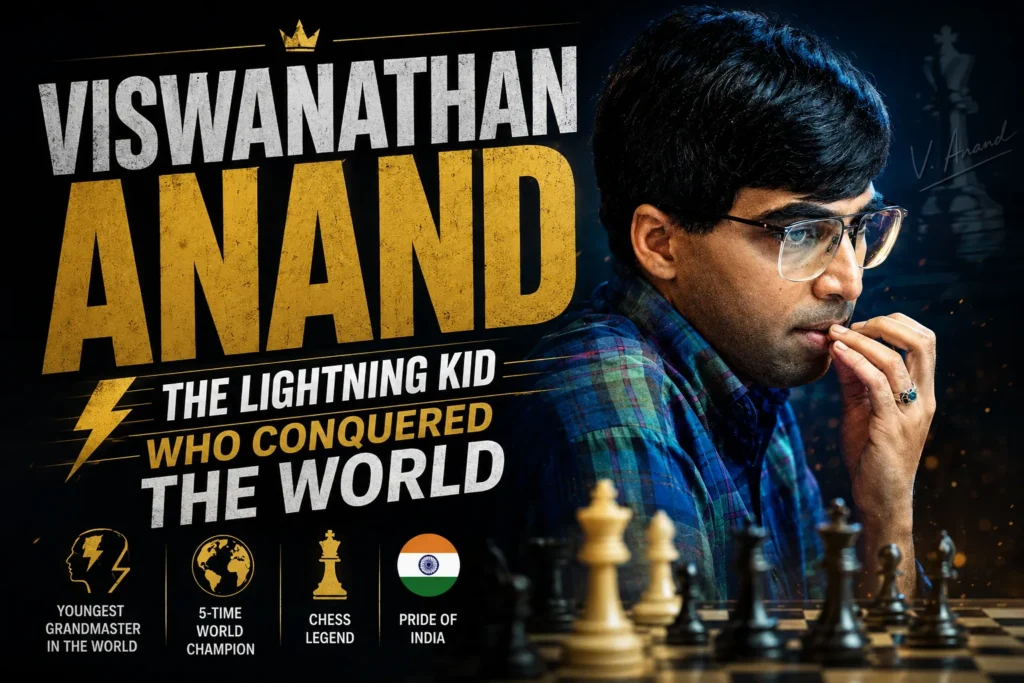
📌 Viswanathan Anand – Quick Facts
| Full Name | Viswanathan Anand |
| Date of Birth | December 11, 1969 |
| Birthplace | Chennai, Tamil Nadu, India |
| Nationality | Indian |
| Marital Status | Married to Aruna Anand (1996); one son |
| Languages Spoken | Tamil, English, Hindi, German, Spanish |
| Title | Grandmaster (awarded 1988 — India’s first) |
| Peak FIDE Rating | 2817 (March 2011) |
| World Champion | 2000–2002 (FIDE), 2007–2013 (Undisputed) |
| Known For | “Lightning Kid” (fast play), first Indian Grandmaster, 5-time World Champion, chess ambassador of India |
| Legacy | Inspired millions in India to play chess, transformed India into a global chess powerhouse, FIDE Deputy President (2022–present) |
Ask any Indian chess enthusiast to name the person who made chess a national obsession, and the answer will be unanimous: Viswanathan Anand. He was India’s first Grandmaster, the country’s first World Champion, and the man who inspired a generation of Indian prodigies. His story is not just about winning — it is about breaking barriers, changing perceptions, and building a legacy that will last for generations.

1. Early Life and Introduction to Chess
Viswanathan Anand was born on December 11, 1969, in Chennai, Tamil Nadu, India. His father, Viswanathan Iyer, was a railway officer, and his mother, Susheela, was a homemaker. Anand grew up in a middle-class Tamil family with a deep appreciation for education and discipline.
Anand learned to play chess at the age of six from his mother. She noticed his natural talent and encouraged him to play. He quickly became fascinated by the game and began participating in local tournaments. By age 14, he had won the Indian Junior Championship.
The Prodigy Emerges
In 1984, at just 14 years old, Anand won the National Sub-Junior Championship. He followed it up with the National Junior Championship in 1985 and the National Senior Championship in 1986 — all while still a teenager. His rapid rise caught the attention of the Indian chess community.
In 1987, Anand won the World Junior Chess Championship in Baguio, Philippines, defeating the top junior players from around the world. This victory announced his arrival on the global stage and earned him the title of International Master.
“I never thought I would become World Champion. I just wanted to play chess and enjoy the game.” — Viswanathan Anand
In 1988, at the age of 18, Anand became the first Indian Grandmaster in history. This was a landmark moment for Indian chess. No Indian had ever achieved this title before, and Anand’s accomplishment inspired countless young players across the country.

2. The Rise to World Championship
Anand’s rise through the international ranks was steady and impressive. He won the Reggio Emilia tournament in 1991, the Alekhine Memorial in 1992, and the Linares tournament in 1998 — one of the most prestigious events in chess.
The 1995 PCA World Championship Match
In 1995, Anand challenged Garry Kasparov for the World Championship under the Professional Chess Association (PCA) banner. The match was held at the World Trade Center in New York. Anand started brilliantly, drawing the first eight games before winning Game 9. However, Kasparov’s experience and preparation proved too strong, and he won the match 10.5–7.5.
The FIDE World Championship Victory (2000)
In 2000, Anand won the FIDE World Chess Championship in Tehran, Iran. He defeated Alexei Shirov in the final by a score of 3.5–0.5. This victory made him the first Indian to become World Chess Champion. The win was a historic moment for India and established Anand as one of the best players in the world.
3. The Undisputed World Champion (2007–2013)
In 2006, the chess world was divided between the FIDE World Champion and the classical World Champion. In 2007, the two titles were unified in a tournament in Mexico City. Anand emerged victorious, winning the tournament and becoming the undisputed World Chess Champion.
2008: Defended Against Kramnik
In 2008, Anand defended his title against Vladimir Kramnik in Bonn, Germany. Anand won the match 6.5–4.5 with two wins and no losses. His victory shocked the chess world, as Kramnik was considered one of the most solid players in history.
2010: Defeated Topalov in a Thriller
In 2010, Anand faced Veselin Topalov in Sofia, Bulgaria. The match was a tense battle. Anand lost the first game but fought back to win the match 6.5–5.5. His victory was a testament to his resilience and fighting spirit.
2012: Defeated Gelfand in Tiebreaks
In 2012, Anand faced Boris Gelfand in Moscow. The match was drawn 6–6, and Anand won the rapid tiebreak 2.5–1.5. This victory made him the oldest undisputed World Champion at age 42.
2013: Lost to Carlsen
In 2013, Anand faced the young Norwegian prodigy Magnus Carlsen in Chennai, India. Carlsen dominated the match, winning 6.5–3.5. Anand’s reign as World Champion came to an end, but he had held the title for an incredible six years.

4. The Playing Style
Anand is known for his exceptional speed, tactical sharpness, and deep positional understanding. He is one of the fastest calculators in chess history, often finding winning moves in complex positions where others see only complications.
The Lightning Kid
Anand earned the nickname “Lightning Kid” because of his incredible speed in rapid and blitz chess. He was one of the first players to master fast time controls, and his success in rapid and blitz tournaments inspired a new generation of players to focus on speed.
Opening Preparation
Anand is known for his vast opening knowledge and his ability to play almost any opening. He has played everything from the solid Ruy Lopez to the sharp Sicilian Defense, adapting his style to suit his opponent.
“Anand is one of the most complete players in history. He can play any position, any opening, and any time control.” — Garry Kasparov
5. The Ambassador of Indian Chess
Anand’s impact on Indian chess cannot be overstated. Before him, chess was a niche game in India. After his World Championship victory in 2000, chess became a national obsession. Thousands of young players took up the game, and India began producing grandmasters at an unprecedented rate.
Players like Pentala Harikrishna, Krishnan Sasikiran, and later Rameshbabu Praggnanandhaa, Nihal Sarin, and D. Gukesh all credit Anand as their inspiration. His success proved that Indians could compete at the highest level, and his humility and grace made him a role model for millions.
Inspiring a Generation
Today, India has over 80 active grandmasters, and the country is considered one of the strongest chess nations in the world. This transformation is directly attributable to Anand’s success and his commitment to promoting chess in India.
6. Later Career and Continued Relevance
Even after losing the World Championship in 2013, Anand continued to compete at the highest level. He won the World Rapid Championship in 2017 and the World Blitz Championship in 2017, proving that he remained one of the best in fast time controls.
In 2022, Anand was elected Deputy President of FIDE, the World Chess Federation. He continues to be an influential figure in the chess world, and his presence in FIDE ensures that the interests of players and developing nations are represented.
Chess and the Indian Prodigies
Anand has played a significant role in mentoring the next generation of Indian players. He has trained with Gukesh, Praggnanandhaa, and others, sharing his knowledge and experience. He often says that the future of Indian chess is bright, and he is proud to be part of its growth.
7. Legacy and Statistical Achievements
Viswanathan Anand is widely considered one of the greatest chess players of all time. His legacy includes:
- World Champion: 5 times (2000–2002, 2007–2013)
- First Indian Grandmaster: 1988
- Peak Rating: 2817 (March 2011)
- World Rapid Champion: 2017
- World Blitz Champion: 2017
- Chess Oscar: 1997, 1998, 2003, 2004, 2007, 2008
- FIDE Deputy President: 2022–present
8. The Full Game: Anand vs. Kramnik, Bonn 2008 (Game 3)
Below is one of Anand’s most famous victories — Game 3 of the 2008 World Championship match against Vladimir Kramnik. Anand played a brilliant attacking game to take the lead in the match.
| Event: | World Championship, Bonn, Germany |
| Date: | October 18, 2008 |
| White: | Viswanathan Anand |
| Black: | Vladimir Kramnik |
| Result: | 1-0 |
1. e4 c5 2. Nf3 Nc6 3. d4 cxd4 4. Nxd4 Nf6 5. Nc3 e5 6. Ndb5 d6
7. Bg5 a6 8. Na3 b5 9. Nd5 Be7 10. Bxf6 Bxf6 11. c3 O-O
12. Nc2 Bg5 13. a4 bxa4 14. Rxa4 a5 15. Bc4 Rb8 16. b3 Kh8
17. Nce3 g6 18. O-O Bg7 19. Qd2 d5 20. exd5 Nb4 21. Rxa5 Nxd5
22. Nxd5 Bxd5 23. Bd3 e4 24. Bb1 Qb6 25. Qe2 Bxg2 26. Kxg2 Qc6+
27. Kg1 e3 28. fxe3 Qxc3 29. Qf2 Qe5 30. Rf5 Qe6 31. h3 Bd4+
32. Kh1 Rbe8 33. Qg3 Kg8 34. Rf4 Bb6 35. Ne3 Re5 36. Rf3 Qe7
37. Qg4 Qe8 38. Nd5 Bc5 39. Rf8+ Qxf8 40. Qxc8 Qxf8 41. Bf5
9. Anand’s Contributions to Chess
Anand has contributed to chess in many ways beyond his victories:
- Chess Education: He has promoted chess in schools and universities, encouraging young players to take up the game.
- Online Chess: He was one of the first top players to embrace online chess, playing on platforms like Chess.com and Lichess.
- FIDE Leadership: As Deputy President, he works to make chess more inclusive and accessible to players from developing nations.
- Author: Anand has written books about his games, including the acclaimed “My Great Games” series.
10. Conclusion
Viswanathan Anand is a giant of the game. He broke barriers when India had no chess tradition. He inspired millions to take up the game. He won championships against the greatest players of his era. And he did it all with grace, humility, and a smile.
Today, Indian chess is thriving. Young players are breaking records, winning tournaments, and challenging for world titles. And it all started with one man from Chennai who believed he could conquer the world — and did.
Viswanathan Anand is not just a World Champion. He is the father of Indian chess. And his legacy will inspire generations to come.

Prochess.Online
prochess.online is built and maintained independently, focused on free, privacy-first chess tools powered by Stockfish 18.