Bobby Fischer: The Genius, The Madman, The Legend
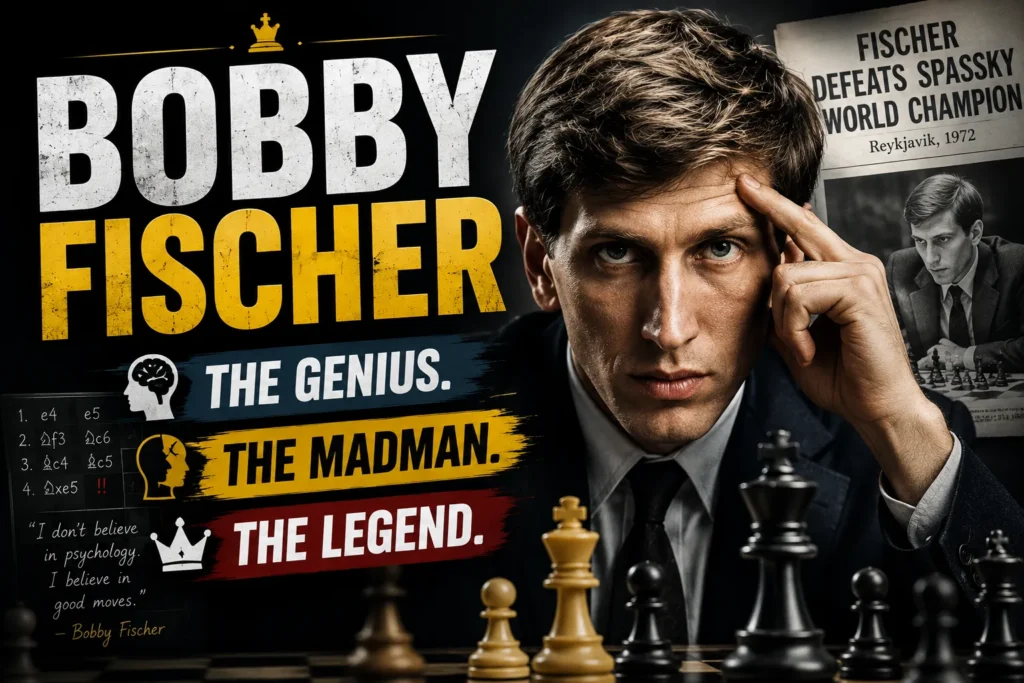
📌 Bobby Fischer – Quick Facts
| Full Name | Robert James Fischer |
| Date of Birth | March 9, 1943 |
| Birthplace | Chicago, Illinois, USA |
| Date of Death | January 17, 2008 (aged 64) |
| Place of Death | Reykjavík, Iceland |
| Nationality | American (later Icelandic citizen) |
| Title | Grandmaster (awarded 1958, age 15 — youngest at the time) |
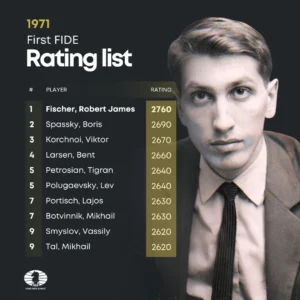
| Peak FIDE Rating | 2785 (July 1972) — first player to break 2780 |
| World Champion | 1972–1975 (forfeited title without playing) |
| Known For | “Game of the Century” (1956), Cold War match vs. Spassky (1972), Fischer Random Chess (Chess960), controversial personality |
| Legacy | First American World Champion, revolutionized chess preparation, inspired millions, but lived a tragic life of isolation |
Ask any chess enthusiast to name the most brilliant, mysterious, and tragic figure in the history of the game, and most will say Bobby Fischer. He was the man who single-handedly broke the Soviet stranglehold on chess, became an American Cold War hero, and then descended into paranoia and exile. His story is not just about chess — it is about genius, obsession, and the fine line between the two.
1. Early Life and Discovery of Chess
Robert James Fischer was born on March 9, 1943, in Chicago, Illinois. His mother, Regina Wender Fischer, was a Polish-Jewish immigrant, and his father, Hans-Gerhardt Fischer, was a German biophysicist. His parents divorced when he was young, and Bobby was raised by his mother in Brooklyn, New York.
At age six, his older sister Joan brought home a chess set from a candy store. Bobby taught himself the moves from the instruction booklet and was instantly captivated. He spent hours playing against himself, memorizing positions, and analyzing games.
By age eight, he was playing at the Brooklyn Chess Club. By age ten, he was already a force to be reckoned with. Fischer dropped out of high school at 16 to devote himself entirely to chess.
The Prodigy Emerges
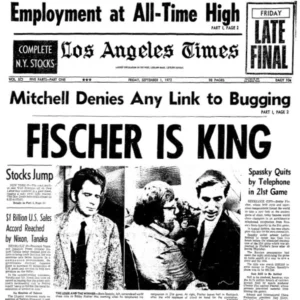
In 1956, at just 13 years old, Fischer played what is now famously known as the “Game of the Century” against Donald Byrne in New York. In that game, Fischer sacrificed his queen on the 17th move to set up a devastating checkmate. The chess world was stunned. This wasn’t just a promising junior — this was a future champion.
“I don’t believe in psychology. I believe in good moves.” — Bobby Fischer
In 1958, at age 15, Fischer became the youngest international grandmaster in history—a record that stood for decades. He won his first of eight U.S. Championships that same year. In the 1964 U.S. Championship, he achieved a perfect score of 11–0, an accomplishment no one has ever repeated.
2. The Road to World Championship
Throughout the 1960s, Fischer dominated American chess but was increasingly frustrated with the politics of the international chess scene. He accused Soviet players of colluding to draw games against each other to prevent him from winning tournaments. He was often right, but his public outbursts made him unpopular with organizers.
The 1970–71 Candidates Matches
Fischer’s path to the 1972 World Championship was nothing short of historic. He won the Candidates matches with unprecedented scores:
- Defeated Mark Taimanov of the USSR 6–0
- Defeated Bent Larsen of Denmark 6–0
- Defeated former World Champion Tigran Petrosian 6.5–2.5
He had won 20 consecutive games against the world’s best players — a feat that may never be repeated. The chess world had never seen such dominance.
3. The Match of the Century: Fischer vs. Spassky (1972)
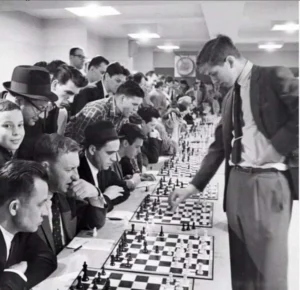
The 1972 World Chess Championship in Reykjavík, Iceland, was more than a chess match — it was a Cold War battle between the United States and the Soviet Union. The Soviet Union had dominated chess since World War II, and Boris Spassky was their champion.
Fischer almost didn’t play. He demanded a larger prize fund, better lighting, and removal of cameras. He arrived late, lost the first game, and forfeited the second game. Everyone thought he would withdraw.
But then, Fischer returned and played some of the greatest games ever seen. He won the match 12.5–8.5, becoming the first American-born World Chess Champion in history.
“Fischer’s victory was a symbolic victory of democracy over Communism.” — The New York Times
The prize fund of $250,000 was more than all previous title matches combined. Fischer had transformed chess from a niche pursuit into a global phenomenon. Chess clubs in America saw a 300% increase in memberships overnight.
4. The Fall from Grace
As champion, Fischer made demands that were impossible to meet. He insisted that the next championship match be played under his own rules, which included playing until someone won 10 games (which could take months). When FIDE refused, Fischer forfeited his title in 1975 without playing a single move, and Anatoly Karpov was declared World Champion by default.
20 Years of Seclusion
Fischer withdrew from competitive chess for nearly 20 years. He lived in obscurity, traveling between Hungary, the Philippines, and Japan. He became increasingly paranoid and made anti-Semitic remarks, despite his mother being Jewish.
In 1992, he re-emerged for a $5 million rematch against Spassky in Yugoslavia — despite U.S. sanctions against the country. Fischer won the match 10–5 and collected $3.35 million. The U.S. government issued a warrant for his arrest, and Fischer never returned to America.
5. Fischer’s Contributions to Chess
Despite his personal demons, Fischer’s legacy to chess is immense:
- Fischer Clock: He patented a chess clock that adds time increments after each move, now standard in all major tournaments.
- Fischer Random Chess (Chess960): He invented a variant where the back row pieces are randomly placed, to reduce the importance of memorized openings and reward creativity and imagination.
- Inspiring a Generation: He made chess mainstream in America, inspiring millions to take up the game.
- Opening Theory: His deep preparation in openings like the Najdorf Sicilian and the King’s Indian Defense changed how chess is played at the highest level.
6. Later Years, Exile, and Death
In July 2004, Fischer was detained at Narita Airport in Tokyo for trying to leave Japan with a revoked U.S. passport. He fought extradition to the United States. In March 2005, Iceland granted him citizenship, and he moved to Reykjavík, the site of his greatest triumph.
Bobby Fischer died of kidney failure on January 17, 2008, at the age of 64, in Reykjavík, Iceland. His funeral was attended by only a handful of people. The man who had once been the most famous chess player in the world died in relative obscurity.
“Fischer was a genius, but he was also a deeply troubled man. His story is a cautionary tale about the price of obsession.” — Garry Kasparov
7. The Game of the Century (1956) – Full Score
Below is the complete game record from Fischer’s famous victory against Donald Byrne at the Rosenwald Memorial Tournament in New York. Fischer was only 13 years old.
| Event: | Rosenwald Memorial, New York |
| Date: | October 17, 1956 |
| White: | Donald Byrne |
| Black: | Robert Fischer |
| Result: | 0-1 (Fischer wins) |
1. Nf3 Nf6 2. c4 g6 3. Nc3 Bg7 4. d4 O-O 5. Bf4 d5 6. Qb3 dxc4
7. Qxc4 c6 8. e4 Nbd7 9. Rd1 Nb6 10. Qc5 Bg4 11. Bg5 Na4
12. Qa3 Nxc3 13. bxc3 Nxe4 14. Bxe7 Qb6 15. Bc4 Nxc3
16. Bc5 Rfe8+ 17. Kf1 Be6 18. Bxb6 Bxc4+ 19. Kg1 Ne2+
20. Kf1 Nxg3+ 21. Kg1 Nxf1+ 22. Kxf1 Bxe7 23. Qxe7 Re8
24. Qf6 Rxe1+ 25. Kxe1 Bd3 26. Rxd3 Re8+ 27. Kd1 Bf8 0-1
8. Fischer’s Greatest Games
Fischer played many brilliant games. Here are three more that are considered masterpieces:
Game 1: Fischer vs. Spassky, Reykjavík 1972 (Game 6)
In the sixth game of the World Championship match, Fischer played a stunning queen sacrifice against Spassky. He offered his queen on move 18 and forced a completely winning position. It is considered one of the greatest games ever played in a World Championship match.
Game 2: Fischer vs. Taimanov, Vancouver 1971 (Game 1)
In the Candidates match against Mark Taimanov, Fischer won all six games. Game 1 featured a powerful exchange sacrifice and a relentless attack. Taimanov later said, “I felt like I was playing against a machine.”
Game 3: Fischer vs. Byrne, New York 1963
In this game, Fischer played a brilliant combination against Robert Byrne, sacrificing a rook and a knight to deliver checkmate. The game is often cited as one of his most impressive tactical displays.
9. Fischer’s Legacy and Influence
Bobby Fischer remains one of the most fascinating and tragic figures in sports history. His life was a paradox — a man of extraordinary intellect who descended into darkness. He revolutionized chess, broke Soviet dominance, and inspired millions. But he also showed us that genius does not guarantee happiness.
His games are still studied by every serious chess player. His name is still whispered with awe. He was, and remains, the American chess legend.
Statistical Achievements
- Youngest Grandmaster: 15 years (record at the time)
- Perfect U.S. Championship Score: 11–0 (1964)
- Candidates Matches Record: 20 consecutive wins (1970–71)
- World Champion: 1972–1975
- Peak Rating: 2785 (July 1972)
10. Conclusion
Bobby Fischer’s story is one of brilliance and tragedy. He was a man who could see chess positions with a clarity that no one else could match. He was a rebel, a genius, and a recluse. He changed the game forever and then walked away from it.
His legacy is secure as one of the greatest players who ever lived. But his life serves as a reminder that genius, without balance, can be a curse. Fischer’s name will forever be etched in the history of chess — a legend who was both celebrated and feared, adored and pitied.

Prochess.Online
prochess.online is built and maintained independently, focused on free, privacy-first chess tools powered by Stockfish 18.