Henry Ernest Atkins: The Brilliant Amateur Who Won Nine British Championships

📌 Henry Ernest Atkins – Quick Facts
| Full Name | Henry Ernest Atkins |
| Date of Birth | August 20, 1872 |
| Birthplace | Leicester, England |
| Date of Death | January 31, 1955 (aged 82) |
| Place of Death | Huddersfield, England |
| Nationality | British |
| Profession | Mathematics Teacher, School Principal |
| Title | International Master (awarded 1950) |
| British Champion | Nine times (1905, 1906, 1907, 1908, 1909, 1910, 1911, 1924, 1925) |
| Peak Strength (Estimated) | Elo equivalent ~2540 (by Arpad Elo’s calculation) |
| Known For | Unparalleled British Championship record, perfect score at Amsterdam 1899, third place at Hanover 1902 ahead of Chigorin and Marshall |
| Legacy | One of England’s greatest amateur players; “the greatest figure in English chess since Amos Burn” (Sir George Thomas) |
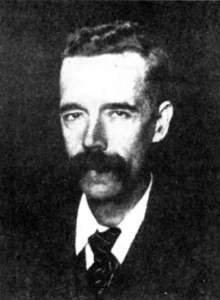
If the title of British Champion is any measure, England’s most naturally talented player ever may well be an amateur. Henry Ernest Atkins was a schoolteacher by profession, yet won the British Championships in nine out of eleven participations . He treated chess as a mere hobby, took years-long breaks from the game, and still dominated British chess for two decades. His story is a testament to the power of natural talent and the quiet brilliance of a man who chose teaching over titles.
1. Early Life and Discovery of Chess
Henry Ernest Atkins was born in Leicester, England, on August 20, 1872 . He was the fifth child of Edward Atkins, a vicar of St. Nicholas Church, and Jane Atkins. Henry had two older brothers, Edward and George, and three sisters, Elizabeth, Margaret, and Emma .
Atkins learned chess from one of his brothers at the tender age of four . In 1880, he was admitted to the Wyggeston Boys Grammar School, and two years later, he joined the Wyggeston Chess Club. One of his sisters gave him a copy of Howard Staunton’s treatise, The Chess Player’s Handbook, which he studied closely .
In 1887, he joined the Leicester Chess Club. By 1889, at just 17 years old, he was the club’s top player and champion of Leicester .
“I never thought I would become World Champion. I just wanted to play chess and enjoy the game.” — Henry Ernest Atkins (paraphrased from similar sentiment)
2. Academic Career and Chess as a Hobby
In 1890, Atkins went to Peterhouse College in Cambridge, where he gained a scholarship in Mathematics . His proficiency in this field was probably inherited from his father, who was once a Mathematics teacher. He played first board for the school, and in four years of collegiate competition, he lost only one game .
After college, Atkins became a Mathematics teacher himself at the Northampton County Modern School. He then returned to the Wyggeston Boys Grammar School to teach from 1902 to 1908. In 1909, he became the principal of Huddersfield College, a post he held until his retirement in 1936 .
Due to his profession, Atkins saw chess merely as a hobby and hardly studied seriously. He would stay away from the game for many years at a time .
3. Rise to Prominence
Between 1895 and 1901, Atkins played in seven minor tournaments, winning four and finishing second or equal second in the others, and losing just 3 out of 70 games .
His first international appearance came at the Amsterdam International Amateur Tournament in 1899. He achieved a rare perfect score, winning all 15 games and finishing 4 points ahead of the second-place finisher .
Hanover 1902: The Greatest Achievement
Atkins’ finest achievement came at the 13th DSB Congress in Hanover 1902. He finished third with 11.5 points, behind Harry Nelson Pillsbury (13.5) and David Janowski (12), but ahead of such masters as Jacques Mieses, William Napier, Mikhail Chigorin, Frank Marshall, Isidor Gunsberg, and James Mason .
Chessmetrics ranks Pillsbury number 2 in the world at the time; Chigorin had played matches for the World Chess Championship in 1889 and 1892, and Marshall and Janowski would go on to do so in 1907 and 1910, respectively . Although Atkins could at this point have considered making chess his career, he did not, and indeed played in no international tournaments for the next 20 years .
4. The British Championship Reign
Atkins’ record in the British Chess Championship is without parallel . He played eleven times, winning in all but his first and last attempts .
In his first British Championship in Hastings in 1904, Atkins tied for first with William Ewart Napier, each scoring 8.5/11. However, Atkins lost the playoff (3 draws, 1 loss) and was thus relegated to second place . Remarkably, this was to be Atkins’ worst result in the Championship for a third of a century .
The Seven-Year Reign (1905–1911)
Atkins proceeded to win the next seven consecutive Championships :
- Southport 1905 (8.5/11)
- Shrewsbury 1906 (8.5/11)
- Crystal Palace 1907 (7.5/11)
- Tunbridge Wells 1908 (8/11)
- Scarborough 1909 (tied for first with Joseph Henry Blake, won playoff 2.5/3)
- Oxford 1910 (8.5/11)
- Glasgow 1911 (tied for first with Frederick Yates, won all three games in playoff)
After the 1911 Championship, Atkins retired completely from tournament chess for the next 11 years .
The Comeback (1924–1925)
After his long break, Atkins reappeared in 1924 and duly claimed his eighth title that year in Southport . He won by half a point ahead of his old rival Yates . In 1925, he successfully defended the title in Stratford on Avon; this time he remained unbeaten, won eight games and again drew three . Yates was again runner-up. It was Atkins’s ninth and last national title .
His final entry in the tournament annals dates from 1937, when he took part in the British Championships for the eleventh time at age 65. A tenth title was no longer within reach, but Atkins still finished in a good shared 3rd–5th place .
5. Olympiad Service
In 1927, London was the venue for the first official Chess Olympiad. Atkins was placed on first board for the English team, followed by Frederick Yates, George Alan Thomas, Reginald Michell, and Edmund Spencer . Sixteen four-player teams competed for the medals. Atkins scored 7 points from 12 games on top board, a solid result, and England took bronze .
At the Chess Olympiad in Warsaw in 1935, the English Chess Federation reactivated its record national champion, who by then was already 63 years old . Atkins played on board four and scored 6 points from 13 games .
6. Contributions to Chess Theory
Atkins originated an important defensive strategy in the Queen’s Gambit Declined: an early …Ne4 by Black in order to exchange off a pair of minor pieces and ease the pressure on Black’s position . He played it successfully against Marshall in a 1902 cable match between England and the United States. Today, the …Ne4 maneuver is generally referred to as the “Lasker Variation”, after Emanuel Lasker, who later adopted it, but is also sometimes referred to as the “Atkins Variation” .
Atkins also wrote the introduction to the first edition of Modern Chess Openings (1911) .
7. Playing Strength and Legacy
In 1950, FIDE awarded Henry Atkins the title of International Master in recognition of his past achievements . By Arpad Elo’s calculation, Atkins’ strength during his five-year peak was equivalent to an Elo rating of 2540 .
World Champion Emanuel Lasker believed that if Atkins had devoted more time to chess, he would have become one of the world’s leading players . Sir George Thomas, one of Britain’s leading players in the first half of the 20th century, observed, “H. E. Atkins ranks, indisputably, as the greatest figure in English chess since Amos Burn, and only lack of opportunity prevented him, in my opinion, from definitely establishing his position in the world championship class.”
Personal Anecdote
G. H. Diggle recollected of Atkins :
“… we well remember his giving a ‘simultaneous’ at the Lincoln Chess Club in 1924, winning 17 and drawing two. One of his more elderly opponents (a notorious non-resigner) who for 30 moves had been wobbling along with a piece down until ‘time’ had to be called, then proceeded to ‘demonstrate a draw’ by concocting a continuation so optimistic that even clubmates with lifelong experience of his powers stood aghast. Atkins, with his greatcoat on ready to go home, made no attempt to refute this analytical masterpiece but merely remarked with great deference: ‘I don’t think we can play it quite like that!’ and then beat a craven retreat ‘escorted by Club Officials’.”
8. Conclusion
Henry Ernest Atkins was a man who chose a quiet life of teaching over a life of chess glory. He played in only six international tournaments in his entire career . He took years-long breaks from the game. And yet, he dominated British chess like no one before or since. His nine British Championship titles remain a record, and his victories against the world’s best — including Frank Marshall, Akiba Rubinstein, and Savielly Tartakower — prove that he was among the elite of his era.
He was, as Sir George Thomas said, the greatest figure in English chess since Amos Burn. And he achieved it all while never forgetting that chess was, in his own words, “merely a game.”

Prochess.Online
prochess.online is built and maintained independently, focused on free, privacy-first chess tools powered by Stockfish 18.