Top 5 Chess Books of 2026: Reviews for Every Level
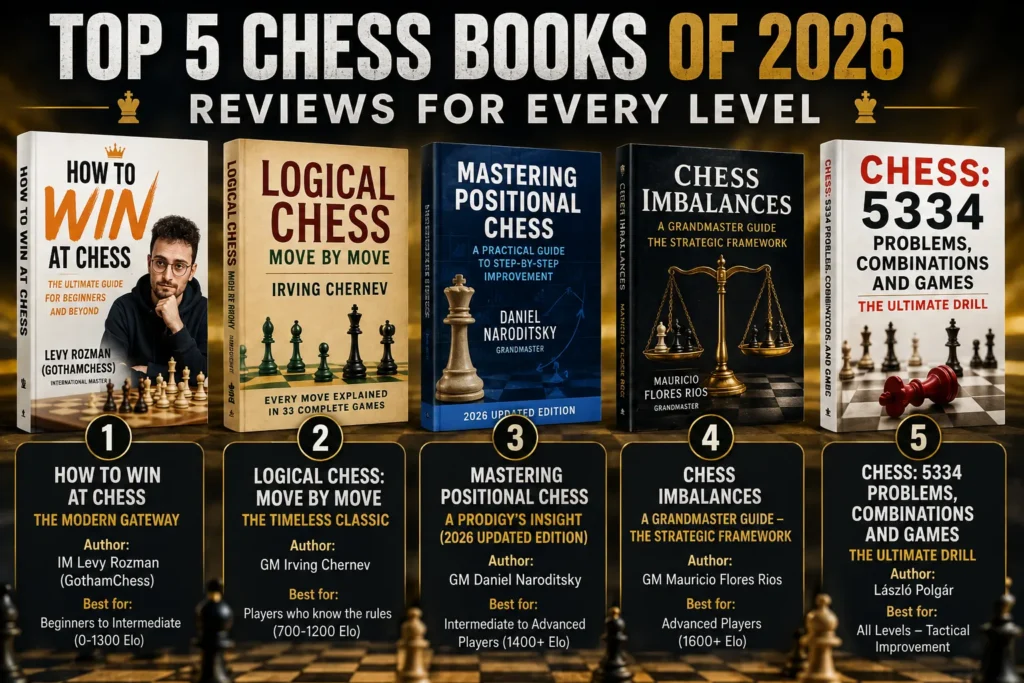
The chess book market in 2026 is more vibrant than ever. With the rise of online chess and a new generation of players hungry for improvement, publishers are releasing everything from updated classics to fresh, modern guides. But with so many options, choosing the right book for your level can be overwhelming. This review cuts through the noise, offering an in-depth look at five books that genuinely deliver value. We’ve selected them to cover different levels and needs, from absolute beginners to ambitious improvers.
Before we dive in, there is one essential piece of advice: always check the notation before you buy. Modern editions use algebraic notation (1. e4), which is what every app, website, and current book uses. Some older printings use descriptive notation (1. P-K4), which can add unnecessary friction for a new learner. The algebraic reprint is the one you want.
1. How to Win at Chess – The Modern Gateway
Author: IM Levy Rozman (GothamChess)
Best for: Beginners to Intermediate (0-1300 Elo)
Published: March 2026
Levy Rozman, the International Master behind the massively popular GothamChess YouTube channel, has created what might be the definitive modern beginner’s guide. His book, How to Win at Chess, leverages his unique teaching style that has made chess accessible to millions. Unlike the dry, dense texts of the past, this book feels like a conversation with a knowledgeable, encouraging friend.
The book is cleverly divided into two halves. The first section introduces rising players (0-800 Elo) to the four key areas: openings, endings, tactics, and strategy. The second half builds upon these core skills for more experienced players (800-1300 Elo). It’s brimming with practical and easy-to-follow tips, featuring over 500 instructional gameplay illustrations to help you visualize the board. It even includes chapter-specific QR codes for exclusive bonus content on Chessly, Rozman’s teaching platform.
What We Liked:
- Internet-Friendly Tone: The language is modern, clear, and avoids the stuffy jargon that plagues many older books.
- Teaches Good Habits: It’s not just about winning; it focuses on time management, common mistakes, and building a solid foundation from the start.
- Highly Visual: The huge, clear diagrams and modern layout make learning intuitive.
What to Consider: For players already over 1300 Elo, this might be too basic. It serves best as a comprehensive on-ramp, not a deep dive into theoretical complexity.
2. Logical Chess: Move by Move – The Timeless Classic
Author: GM Irving Chernev
Best for: Players who know the rules (700-1200 Elo)
Published: Classic (Updated Editions Available)
Irving Chernev’s Logical Chess: Move by Move is our pick for the best chess book for most readers, and it wins on a single promise kept: every move of every game is explained. Not just the critical moments — every move, including the quiet ones, across 33 complete games. “Why did they play that?” is the question beginners actually have, and this is the rare book that never skips it.
Chernev repeats himself, and stronger players will find some explanations simplified. Both are features at this level. Repetition is how ideas like “develop toward the center” and “don’t move the same piece twice in the opening” stop being rules you recite and start being things you see. He teaches you the logic behind the moves, helping you understand not just where to move pieces but why.
What We Liked:
- Every Move Explained: This is the book’s superpower. You never feel lost or left to guess.
- Teaches Plans, Not Memorization: It builds a solid, practical foundation for understanding the game.
- High Impact: Numerous players report significant rating increases after working through this book.
What to Consider: The games are from an older era, which is actually a benefit for beginners (fewer modern complexities). However, be sure to buy a modern edition with algebraic notation. If you read one chess book cover to cover in your life, many would argue this should be the one.
3. Mastering Positional Chess – A Prodigy’s Insight (2026 Updated Edition)
Author: GM Daniel Naroditsky
Best for: Intermediate to Advanced Players (1400+ Elo)
Published: Updated Edition (August 2026)
This book is remarkable both for its author and its content. Grandmaster Daniel Naroditsky, who tragically passed away in 2025, was a beloved chess educator. He wrote the original Mastering Positional Chess when he was just 14 years old, making him the youngest author ever to publish a chess book. The 2026 edition has been significantly updated, making this foundational work relevant for modern players.
Naroditsky was a World U12 Champion and a Grandmaster at 17. In this ambitious work, he explains clear positional themes in complex settings. Drawing on his own games, those of US colleagues, and top-level grandmasters, he navigates chess strategy with the liveliness and clarity he became famous for on his popular Twitch and YouTube channels.
What We Liked:
- Exceptional Author: Naroditsky was widely respected as an educator; his explanations are clear, humorous, and instructive.
- Targeted Positional Study: This book tackles the strategic understanding that separates good players from great ones.
- Updated Content: The 2026 edition ensures modern examples and concepts, avoiding the dated feel of some classic strategy books.
What to Consider: This is not a beginner book. It’s best suited for players who have a solid grasp of tactics and basic strategy and are ready to delve deeper into positional chess. It’s a pre-order title with a publication date of August 26, 2026, so be sure to check the release status.
4. Chess Imbalances: A Grandmaster Guide – The Strategic Framework
Author: GM Mauricio Flores Rios
Best for: Advanced Club Players (1600+ Elo)
Published: 2026
Navigating positions with imbalances and knowing how to evaluate them over the board is an essential skill for any chess player. It’s also one of the hardest strategic concepts for improving players to grasp. GM Mauricio Flores Rios has created a guide on each important imbalance with perfectly annotated textbook examples, easy-to-follow rules, and general concepts for each, explaining the most important features of each type of position.
His previous masterpiece, Chess Structures, was structured in a similar fashion, and he has managed to include more of everything that was good in the first book into Chess Imbalances. This book breaks down complex strategic concepts like material, space, development, and pawn weaknesses into a systematic, learnable framework.
What We Liked:
- Systematic Approach: It provides a clear framework for evaluating positions, which is crucial for strategic improvement.
- Perfectly Annotated Examples: The book explains the “why” behind the concepts, not just the “what”.
- High-Level Insight: It helps ambitious players understand the thought processes of grandmasters.
What to Consider: This book is dense and challenging. It is not a light read and is best suited for players who are serious about improving their positional understanding.
5. Chess: 5334 Problems, Combinations and Games – The Ultimate Drill
Author: László Polgár
Best for: Any Level (800-2000+ Elo) for Tactics Training
Published: Classic (Updated Editions Available)
This book is legendary. László Polgár, father of the famous Polgár sisters (all three became grandmasters), used this collection as the foundation for their training. Chess: 5334 Problems, Combinations and Games is an enormous, single-volume compilation of 5,334 puzzles organized by theme and difficulty, covering checkmates in one through four moves, tactical combinations, and strategic positions.
The book is organized so you can pick it up for 15 minutes or spend an hour without losing your place. It covers virtually every tactical pattern at every difficulty level, making it an invaluable resource for players at any stage.
What We Liked:
- Unmatched Breadth: It covers every tactical pattern you’re likely to encounter.
- Organized by Theme: Makes it easy to drill specific weaknesses.
- Incredible Value: For the volume of material, the price-to-content ratio is outstanding.
What to Consider: There are no explanations or answers with commentary — you’re on your own to find the solution. Its physical size (it’s a large hardcover) can make it awkward to use at a board. However, as a drill book, it remains the standard by which all others are judged.
Final Thoughts
Choosing the right chess book comes down to identifying your level and your goals. If you’re just starting, How to Win at Chess is the most welcoming, modern gateway, while Logical Chess remains the best choice for understanding the core principles. For those ready to move beyond basic tactics, the works of Naroditsky and Flores Rios offer deep dives into strategy and positional play. And for sheer tactical drilling, the Polgár collection is an unparalleled resource.
Whichever you choose, remember that a chess book is a tool. It works best when used alongside a real board, with a willingness to play through the moves and understand the reasons behind them. Happy reading, and happy improving!
“`

Prochess.Online
prochess.online is built and maintained independently, focused on free, privacy-first chess tools powered by Stockfish 18.