Magnus Carlsen: The Story of Chess’s Greatest Modern Champion
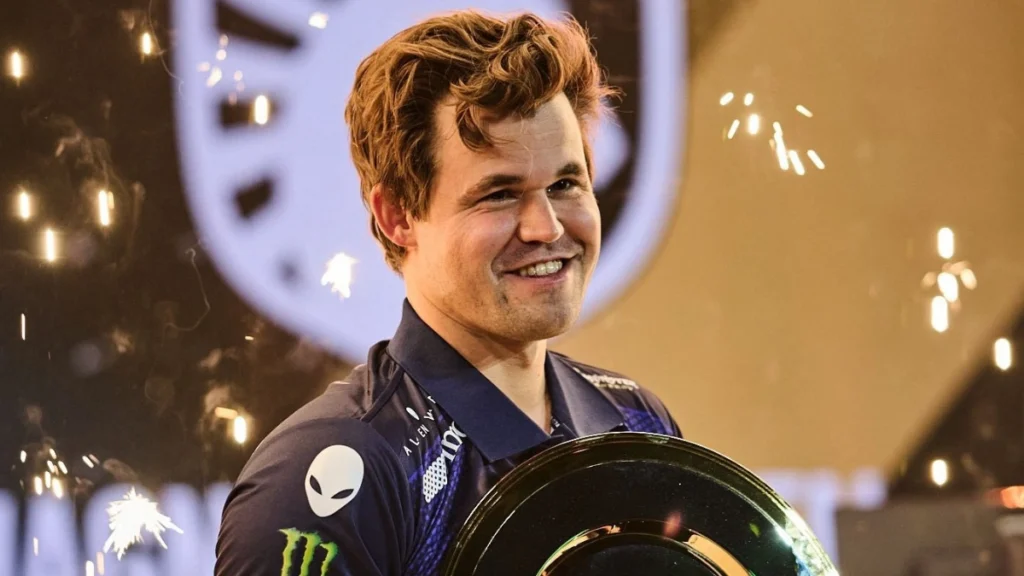
- Full Name: Sven Magnus Øen Carlsen
- Date of Birth: November 30, 1990
- Birthplace: Tønsberg, Norway
- Nationality: Norwegian
- Marital Status: Married to Ella Victoria Malone (2025); one child
- Languages Spoken: Norwegian (native), fluent English, conversational Dutch and Swedish
- Title: Grandmaster (awarded 2004, age 13)
- Peak FIDE Rating: 2882 (2014) — the highest in chess history
- Current FIDE Rating: Around 2840, World No. 1 (2026)
- Estimated Net Worth: Widely reported between $25 million and $50 million+ (estimates vary significantly by source)
Ask almost anyone with even a passing interest in chess to name a player, and there’s a very good chance the first name out of their mouth will be Magnus Carlsen. For well over a decade, the Norwegian grandmaster hasn’t just been the best player in the world — he’s been the face of the entire sport, the reason millions of people who had never touched a chessboard suddenly started watching chess on their phones. His story is unusual, not because of a single dramatic triumph, but because of just how long and how completely he has dominated a game that rarely produces one clear “best ever.”
Who Is Magnus Carlsen?
Magnus Carlsen is a Norwegian chess grandmaster widely regarded as the strongest player of his generation, and by many measures, the strongest player in the history of the game. He held the classical World Chess Championship title from 2013 to 2023, has topped the FIDE world rankings continuously since mid-2011, and holds the record for the highest classical rating ever achieved. Beyond his over-the-board results, Carlsen has become a genuine media personality — a streamer, a businessman, and one of the very few chess players recognizable to people who don’t follow chess at all.
Where Did Magnus Carlsen Grow Up?
Carlsen was born in Tønsberg, a small coastal city south of Oslo, to Sigrun Øen, a chemical engineer, and Henrik Albert Carlsen, an IT consultant who enjoyed chess as a hobby. He spent portions of his early childhood abroad, living for stretches in Finland and Belgium as his family relocated for his father’s work, before the Carlsens eventually settled back in Norway.
Even before he touched a chessboard, young Magnus stood out. Family accounts describe him solving complex jigsaw puzzles designed for much older children before he was even three years old, and building elaborate structures with building blocks well beyond what would be expected for his age. He had, in other words, an unusually sharp memory and a taste for problems long before chess entered the picture.
How Did Magnus Carlsen Start Playing Chess?
Somewhat surprisingly for a future world champion, Carlsen’s first encounter with chess wasn’t love at first sight. His father taught him the rules at around age five, mostly hoping to share a hobby with his son, but Magnus didn’t take to the game immediately. It took a couple more years, and quite possibly a healthy dose of sibling competitiveness with his older sister, before he began engaging with chess seriously.
Once the interest clicked, though, it clicked hard. Carlsen began devouring chess books and studying games obsessively, and by age eight he was already competing in his first Norwegian Chess Championship. From there, his progress was fast even by prodigy standards — within a few years he was traveling internationally, testing himself against seasoned adult players, and rapidly climbing through the rating ranks that usually take players a full career to conquer.
When Did He Become a Grandmaster?
Carlsen earned the Grandmaster title in 2004, at just 13 years old, making him one of the youngest grandmasters in history at the time. He trained at Norway’s College of Elite Sport under Grandmaster Simen Agdestein, one of the strongest Norwegian players of the previous generation, who helped sharpen the raw talent that Carlsen had already shown in his early tournament results. Between 2000 and 2002 alone, Carlsen played hundreds of rated games, an intense schedule that accelerated his development far faster than a typical junior player’s.
When Did He Become World Number One?
Carlsen’s rise from promising teenager to the very top of the sport didn’t take long. He first reached the World No. 1 ranking in January 2010, while still a teenager, an achievement that made him the youngest player ever to top the FIDE rating list. But the more remarkable feat came the following year: since July 1, 2011, Carlsen has held the World No. 1 spot continuously — a streak of well over a decade with no interruption, unmatched by any other player in chess history.
In 2014, Carlsen pushed his own rating to 2882, a figure that remains the highest classical rating ever recorded. For context, very few players in history have ever crossed the 2800 mark at all; Carlsen not only crossed it but set a ceiling that, more than a decade later, still hasn’t been touched.
When Did He Win the World Chess Championship?
Carlsen won his first World Chess Championship title in 2013, defeating the legendary Indian grandmaster Viswanathan Anand in Chennai, India. It was a changing-of-the-guard moment for the sport — Anand had been the dominant classical world champion of the previous years, and Carlsen’s win signaled the arrival of a new era. Carlsen went on to defend his title multiple times over the following decade against a series of elite challengers, cementing a reign that lasted a full ten years.
Why Did He Give Up His World Championship Title?
In 2022, Carlsen made a decision that stunned the chess world: he announced he would not defend his classical World Championship title in 2023. His reasoning centered on motivation rather than ability — the months of intense, isolating preparation required to face a single opponent in a world championship match had simply stopped feeling worthwhile to him. It was an extraordinary move for an active, undisputed champion to walk away voluntarily, something the sport hadn’t seen since Bobby Fischer declined to defend his title decades earlier.
It’s worth being clear about what this decision was not: it wasn’t retirement, and it wasn’t a decline in strength. Carlsen has remained the highest-rated and most feared player in the world ever since, simply redirecting his competitive focus toward tournaments and formats he finds more enjoyable.
What Other Titles Has He Won?
If classical chess is the marathon of the sport, then rapid and blitz chess are its sprints, and Carlsen has dominated those distances just as thoroughly as the long format. He has won the World Rapid Chess Championship six times and the World Blitz Chess Championship nine times, giving him more combined speed-chess titles than any player in history.
Carlsen has also embraced the newer, faster-growing corners of competitive chess. He won the inaugural chess event at the Esports World Cup in 2025 while playing for Team Liquid, and returned in 2026 to captain Team Norway in the same competition. Earlier in 2026, he added the FIDE Freestyle Chess World Championship to his collection — a modern variant, also known as Chess960, where the starting position of the pieces is shuffled to reduce the role of memorized opening theory. Together, these wins make it clear that Carlsen’s dominance isn’t a relic of his classical peak; it’s an ongoing, current story.
What Makes His Playing Style So Difficult to Beat?
Unlike many elite players who are known for a single signature weapon — a sharp opening repertoire, a love of tactics, a particular structure they specialize in — Carlsen’s reputation rests on the near-total absence of any real weakness. Early in his career, he was known mainly for aggressive, attacking chess. Over time, he evolved into what commentators frequently describe as a “universal player,” someone equally comfortable in a wild tactical melee or a quiet, grinding endgame.
That grinding endgame technique is, in fact, his signature skill. Carlsen has an unusual ability to keep pressing in positions that look completely drawn on paper, patiently improving his position move after move until a tiny, seemingly meaningless advantage turns into a full point. This relentless approach has produced one of the longest unbeaten runs at the elite level in chess history, a streak that stretched past 100 consecutive games without a loss.
What Has He Built Outside of Chess?
Carlsen’s influence on the game extends well beyond his own results at the board. In 2013, he co-founded Play Magnus, a chess technology company built around an app that let ordinary players test themselves against a simulation of Carlsen at different ages. The company grew steadily over the following years and eventually merged with Chess.com in 2022, a deal that significantly expanded Carlsen’s role in shaping how millions of people around the world learn and play chess online.
He has also built a personal brand that few chess players have managed to replicate — sponsorship deals with major companies, a large following on streaming and social platforms, and a natural willingness to needle rivals and commentators that has made him compelling to watch even outside of tournament play. That combination of skill and personality is a large part of why chess found new, younger audiences during the online boom of the past several years.
What Is Magnus Carlsen’s Life Like Outside of Chess?
Carlsen married Ella Victoria Malone in 2025, and the couple welcomed their first child not long afterward. In recent interviews, Carlsen has spoken warmly about fatherhood, describing it as a meaningful shift in how he sees both his career and his day-to-day priorities, even as he continues to compete at the highest level. Away from chess, Carlsen has been open about his interest in fantasy football and card games, hobbies that reportedly help him unwind from the intensity of competitive play.
Why Does He Remain Chess’s Biggest Name?
Even years removed from his classical title, Carlsen remains the central reference point for the entire sport. As of mid-2026, he continues to hold the World No. 1 classical ranking, a position he’s occupied for the better part of two decades. New champions have emerged through the classical world championship cycle, and a wave of talented young players continues to climb the rankings, but none have yet displaced Carlsen as the standard against which every other player in the world is measured.
For a sport that has seen explosive growth thanks to streaming, online platforms, and a new generation of AI-powered training tools, Carlsen’s career acts almost like a bridge — connecting classical chess history to this louder, faster, far more visible modern era. That mix of longevity, sustained dominance, and genuine crossover appeal is exactly why search interest in his name continues to outpace every other player in the game, and likely will for a long time to come.

Prochess.Online
prochess.online is built and maintained independently, focused on free, privacy-first chess tools powered by Stockfish 18.