University Chess Gets Its First-Ever World Championship in Almaty
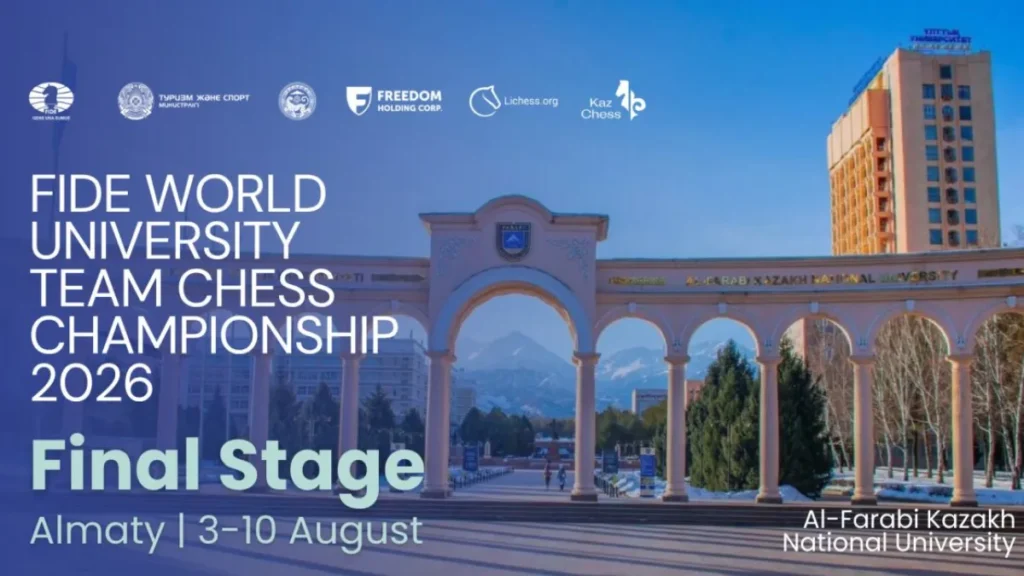
There’s a first time for everything, even in a game as old as chess. From August 3 to 10, Kazakhstan’s largest city, Almaty, will host something that has never technically existed before: a FIDE World Championship built entirely for university teams. Sixteen squads will gather at Al-Farabi Kazakh National University’s Farabi Hall, and while the format is brand new, the ambition behind it is anything but small.
Getting There Wasn’t Easy
None of these sixteen teams simply showed up. Getting to Almaty meant surviving a genuine gauntlet — two regional online qualifiers back in May split the world roughly in half, with Saint Louis University topping the bracket covering the Americas and Africa, and Russia’s Ural State Mining University coming out on top across Europe and Asia. From there, things only got tougher: a 32-team online knockout, played out on Lichess, whittled the field down to just eight direct qualifiers.
FIDE and the organizers then rounded out the field with eight wildcard invitations, bringing the total to sixteen. One of those wildcards went to Almaty Management University, so the host country won’t just be watching from the sidelines — it’ll have a team fighting for the title on its own turf.
Old Names, New Faces
What makes the field genuinely interesting is the mix of pedigree sitting in the same bracket. Oxford, Cambridge, and Harvard are all here, institutions where organized chess has existed in some form for well over a century. And right alongside them are programs writing their own history for the first time. Universitas Gunadarma is pointing out, with some justified pride, that it’s the only team from Southeast Asia to make it this far. The National Technical University of Athens had to fight through two matches against the University of Texas Rio Grande Valley just to get here, and now considers itself among the world’s elite university programs as a result.
If you’re looking for a favorite on paper, though, most signs point back to Ural State Mining University. The Russian team not only topped its qualifier but also beat out opposition from Libya and Mexico in the knockout stage — and it isn’t shy about calling itself the team to beat, largely because it holds the highest average rating of anyone in the field.
How It’s Actually Played
The finals kick off with a group stage before narrowing into knockout rounds to crown a champion. Every match is played on four boards, and there’s one structural rule worth highlighting: each team’s lineup has to include at least one woman and at least one man. It isn’t an afterthought bolted onto the rules — it’s built into the format from the ground up. There’s real money on the line too, with a total prize fund of €50,000, and €25,000 of that going straight to whichever team ends up on top.
To keep things honest as a genuine student competition, eligibility is capped by birth year, so this stays a tournament for current university-age players rather than a loophole for professionals loosely attached to a school.
A Serious Show of Support
This isn’t a small, grassroots affair being run on a shoestring. The championship has real institutional muscle behind it — FIDE, Kazakhstan’s Ministry of Tourism and Sports, the Kazakhstan Chess Federation, the city government of Almaty, Freedom Holding Corp., and Lichess.org, which also ran the online knockout stage. Almaty Management University has been fairly open about what the event means for the country, describing it as a chance to put both the university and Kazakhstan’s broader higher education system in front of an international audience.
Why Bother With a University Championship At All?
University chess itself isn’t new — plenty of countries and regions have run their own versions for years. What’s new here is FIDE putting its full weight behind a genuine world title for it. It fills an awkward gap that’s existed for a while: junior and youth titles stop mattering once a player turns 18 or so, but not everyone talented enough to compete is ready to jump straight into the fully professional circuit. This gives that in-between group, still juggling lecture halls and degree deadlines, something real to aim for instead of just quietly fading out of competitive chess.
With centuries-old institutions like Oxford and Cambridge sharing a playing hall with ambitious young programs from Indonesia, Greece, and Kazakhstan itself, Almaty’s first attempt at this looks like it could become a genuine fixture on the calendar — and an early clue as to which university programs can actually hang with the best in the world.

Prochess.Online
prochess.online is built and maintained independently, focused on free, privacy-first chess tools powered by Stockfish 18.