Garry Kasparov: The Beast from Baku

| Full Name | Garry Kimovich Kasparov (born Garri Weinstein) |
| Date of Birth | April 13, 1963 |
| Birthplace | Baku, Azerbaijan SSR (now Azerbaijan) |
| Nationality | Russian (formerly Soviet), Croatian citizen |
| Marital Status | Married twice; three children |
| Languages Spoken | Russian (native), fluent English, conversational Armenian |
| Title | Grandmaster (awarded 1980, age 17) |
| Peak FIDE Rating | 2851 (July 1999) — highest ever recorded at that time |
| World Champion | 1985–2000 (Undisputed / PCA) |
| Years as World No. 1 | 1986–2005 (255 months — the longest in history) |
| Known For | Youngest undisputed World Champion (22 years, 7 months), epic rivalry with Karpov, Deep Blue matches, political activism against Putin |
Ask any chess enthusiast to name the most aggressive, relentless, and psychologically intimidating player in history, and most will say Garry Kasparov. For over two decades, the Russian grandmaster didn’t just dominate the chessboard — he dominated the entire narrative of the sport. He was the man who broke the Soviet machine’s stranglehold on chess, who took on the might of IBM’s Deep Blue, and who later took on the might of Vladimir Putin. His story is not just about chess; it is about genius, courage, and the unyielding human spirit.
1. Early Life and Introduction to Chess
Garry Kasparov was born Garri Weinstein on April 13, 1963, in Baku, Azerbaijan SSR (now Azerbaijan). His father, Kim Weinstein, was Jewish, and his mother, Klara Shagenovna Kasparova, was Armenian. His parents divorced when he was young, and he was raised by his mother and stepfather. His mother, a teacher, changed his surname to Kasparov at age 11 to avoid anti-Semitic discrimination in the Soviet Union.
Kasparov’s introduction to chess came at the age of 6, when he stumbled upon a chess problem left by his parents. He solved it within minutes and was immediately captivated. His mother encouraged his talent and enrolled him in the Baku Palace of Pioneers, where he began formal training under coach Oleg Privorotsky.
The Prodigy Emerges
By age 10, Kasparov was already a master-level player. He won the Soviet Youth Championship at 13 and the Soviet Junior Championship at 16. His aggressive, attacking style and deep tactical vision set him apart from his peers.
In 1976, at just 13 years old, Kasparov was accepted into the prestigious chess school of Mikhail Botvinnik, the sixth World Champion. Botvinnik recognized Kasparov’s immense potential and personally mentored him. Under Botvinnik’s guidance, Kasparov developed a strong positional understanding and a lethal opening repertoire.
“Kasparov was the most talented player I ever taught. He had an incredible memory, a ferocious will to win, and an unmatched work ethic.” — Mikhail Botvinnik
In 1980, at just 17 years old, Kasparov won the World Junior Chess Championship in Dortmund, Germany, becoming an international grandmaster.
2. The Path to the World Championship
Kasparov’s rise through the Soviet chess ranks was meteoric. The Soviet Union had dominated chess for decades, producing champions like Botvinnik, Smyslov, Tal, Petrosian, Spassky, and Karpov. But Kasparov was different—he was young, brash, and willing to challenge the established order.
The 1982 Interzonal Tournament
In 1982, Kasparov qualified for the Interzonal tournament, the qualifying event for the Candidates matches. He finished in a tie for first place, earning a spot in the Candidates.
The 1983 Candidates Matches
Kasparov defeated Alexander Beliavsky in the quarterfinals and Viktor Korchnoi in the semifinals. The Korchnoi match was particularly dramatic—Korchnoi, a defector from the Soviet Union, was a fierce opponent, but Kasparov won 6–4.
Defeating Smyslov to Become the Challenger
In the 1984 Candidates final, Kasparov faced Vasily Smyslov, the seventh World Champion. Despite Smyslov’s experience, Kasparov won 8.5–4.5, earning the right to challenge Anatoly Karpov for the World Championship.
3. The Epic Rivalry with Anatoly Karpov
The Kasparov-Karpov rivalry is one of the greatest in all of sports. They played five World Championship matches between 1984 and 1990, totaling over 140 games. Their contrasting styles—Karpov’s positional, methodical approach versus Kasparov’s aggressive, dynamic play—made for compelling drama.
The 1984–85 Match: A Marathon of Endurance
The first match, held in Moscow from September 1984 to February 1985, was a grueling marathon. The format was “first to six wins,” with draws not counting. Karpov, the experienced champion, took a 5–0 lead after 27 games. Kasparov seemed finished.
But Kasparov refused to break. He began drawing game after game—17 consecutive draws—to stop the bleeding. Then, in Game 32, Kasparov won his first game. He followed it with two more wins, making the score 5–3.
After 48 games and nearly five months of play, with Karpov leading 5–3, FIDE President Florencio Campomanes halted the match, citing the health of both players. Kasparov was furious, believing he would have eventually won. But the match was abandoned, and a new match was scheduled for 1985.
The 1985 Match: Kasparov Becomes Champion
The 1985 rematch, also held in Moscow, was a 24-game affair. Karpov took an early lead, winning Game 1 and Game 3. But Kasparov responded with wins in Game 5 and Game 7.
Game 16 is considered one of the greatest ever played. Kasparov, playing Black, completely outplayed Karpov in a Sicilian Defense and won in 41 moves.
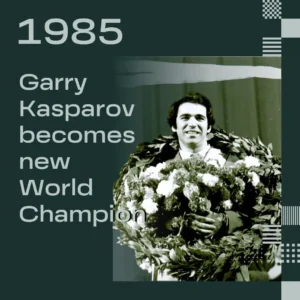
Kasparov won the match 13–11, becoming the youngest undisputed World Chess Champion in history at 22 years and 7 months old.
“I was young, I was fearless, and I had nothing to lose. Karpov was the greatest player of his generation, but I was the next generation.” — Garry Kasparov
Re-Matches: 1986, 1987, and 1990
- 1986 (London and Leningrad): Kasparov won 12.5–11.5.
- 1987 (Seville): Kasparov drew 12–12, retaining his title on tiebreak.
- 1990 (New York and Lyon): Kasparov won 12.5–11.5.
The rivalry produced some of the highest-quality chess ever played and captured the imagination of fans worldwide.
4. The Split from FIDE and the PCA Era
In 1993, Kasparov and challenger Nigel Short were frustrated by FIDE’s handling of the World Championship. FIDE, led by President Florencio Campomanes, had agreed to a bid that both players felt was inadequate in terms of prize money and organization.
Kasparov and Short broke away from FIDE and formed the Professional Chess Association (PCA). They held their own World Championship match in London. FIDE responded by stripping Kasparov of his title and declaring Karpov the FIDE World Champion.
Kasparov defeated Short 12.5–7.5 to become the PCA World Champion.
In 1995, Kasparov defended his PCA title against Viswanathan Anand in New York’s World Trade Center. He won 10.5–7.5.
This split divided the chess world for years, with two world champions—the PCA champion (Kasparov) and the FIDE champion (Karpov, then Khalifman, then Anand). The split was finally healed in 2006 with the reunification match between Kramnik and Topalov.
5. Kasparov vs. Deep Blue: Man vs. Machine
In February 1996, IBM’s chess computer Deep Blue faced Kasparov in a six-game match in Philadelphia. It was the first time a computer had played a reigning World Champion under tournament conditions.
Kasparov won the match 4–2. But in Game 1, Deep Blue made history by becoming the first computer to ever defeat a reigning World Champion. Kasparov was shaken but recovered to win the match.
IBM returned in 1997 with an upgraded Deep Blue. The rematch was held in New York from May 3–11, 1997. Kasparov won Game 1, drew Games 2–5, but then lost Game 6 in 19 moves—a shocking blunder that he later called “a moment of human weakness.”
“I’m a human being. When I see something that is well beyond my understanding, I’m afraid.” — Garry Kasparov, after losing Game 6
Deep Blue won the match 3.5–2.5, making it the first time a computer had defeated a reigning World Champion.
Kasparov accused IBM of cheating, claiming that Deep Blue had received human assistance during the match. IBM denied it and immediately retired Deep Blue. The controversy remains unresolved, but the event changed the perception of artificial intelligence forever.
6. Later Career and Retirement
In 1999, Kasparov reached his peak rating of 2851, the highest ever recorded at the time. He was ranked World No. 1 for most of the 1990s.
In 2000, Kasparov lost the World Championship to his former protégé, Vladimir Kramnik, in London. Kramnik played the Berlin Defense to neutralize Kasparov’s openings, and Kasparov lost 8.5–6.5.
Despite the loss, Kasparov remained the highest-rated player until 2005, when he retired from professional chess to focus on politics and writing.
Writing and Commentating
Kasparov has written extensively about chess. His five-volume series, “Kasparov on My Great Predecessors”, is a monumental work covering every World Champion from Wilhelm Steinitz to Anatoly Karpov. He has also written books on strategy, opening theory, and his own games.
He is a regular commentator at major tournaments and remains one of the most sought-after analysts in the chess world.
7. Political Activism and Exile from Russia
After retiring, Kasparov became a vocal critic of Russian President Vladimir Putin. In 2005, he formed the United Civil Front, an opposition group that opposed Putin’s authoritarian policies.
In 2007, Kasparov helped create “The Other Russia”, a coalition of opposition parties. He announced his candidacy for the Russian presidency in the 2008 election but was unable to register due to alleged government obstruction.
Kasparov was arrested several times at protest rallies. In 2008, he was sentenced to five days in jail for leading an unsanctioned rally.
In 2015, Kasparov published “Winter Is Coming: Why Vladimir Putin and the Enemies of the Free World Must Be Stopped”, in which he warned about Russia’s growing authoritarianism and aggression.
Kasparov now holds Croatian citizenship and lives in the United States. He continues to write and speak about Russian politics, democracy, and human rights.
8. Legacy and Impact on Chess
Garry Kasparov’s legacy is immense. He is widely considered one of the greatest players in history—and some, including Magnus Carlsen, have called him the greatest.
Statistical Achievements
- Youngest undisputed World Champion: 22 years, 7 months
- Longest unbroken reign as World No. 1: 255 months (1986–2005)
- Peak rating: 2851 (July 1999)
- Chess Oscars: Won 11 times (1982, 1983, 1985–1990, 1995, 1999)
Revolutionizing Opening Preparation
Kasparov was the first World Champion to treat opening preparation as a science. He worked with a team of analysts, used computers extensively, and prepared deep, specialized variations that often lasted 20 moves or more.
Bridging Man and Machine
His matches against Deep Blue forced the chess world to accept that computers were becoming stronger than humans. He later embraced chess engines as tools for learning.
“Kasparov was a lethal combination of Fischer and Karpov. He got his positions and then never let go.” — Magnus Carlsen
9. Personal Life and Character
Kasparov is known for his intense will to win, his deep preparation, and his outspoken nature. He has been married twice and has three children.
Despite his reputation for being arrogant, Kasparov has often shown humility when discussing his defeats. He has spoken openly about the psychological toll of the 1984–85 Karpov match and his Deep Blue loss.
10. Conclusion
Garry Kasparov is more than just a chess player. He is a symbol of human excellence, a fighter against oppression, and a voice for freedom. His life story is a testament to the power of intelligence, determination, and courage.
From Baku to the world stage, Kasparov has inspired millions to play chess and to think beyond the board. His influence on the game is still felt today, and his legacy is secure as one of the greatest minds of the 20th century.

Prochess.Online
prochess.online is built and maintained independently, focused on free, privacy-first chess tools powered by Stockfish 18.