European Youth Team Chess Championship 2026 Opens in Pardubice With a Record 65 Teams

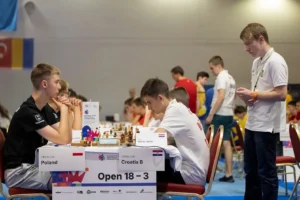
The European Youth Team Chess Championship 2026 got underway this week in Pardubice, Czech Republic, and it arrived with a milestone attached: the largest field in the event’s history. Sixty-five teams and 218 players have descended on the city for what is now one of the most closely watched junior team events on the European chess calendar, continuing a run of steady growth that has seen the championship expand nearly every year.
A Championship That Keeps Growing
To put this year’s numbers in perspective, last year’s edition in Terme Catez, Slovenia, already represented a record at the time, with 63 teams and 220 players representing 18 European federations. Pardubice has now pushed the team count past that mark again, even as the total number of individual players held roughly steady. That pattern — more teams entering, national federations sending additional squads beyond their primary lineup — says something about how seriously European federations are now treating youth team competition as a development pipeline, not just a once-a-year showcase.
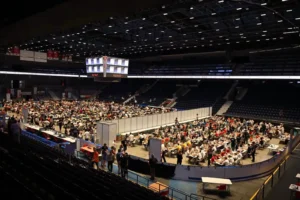
The event runs from July 25th (arrival day) through August 2nd (departure day), with the playing days themselves hosted at the Enteria Arena, a multi-purpose venue in Pardubice built to handle the logistics of hundreds of players, coaches, and support staff across a full week of competition.
How the Championship Is Structured
The tournament is really four championships running in parallel. Players compete in two age categories, Under-12 and Under-18, with separate Open and Girls sections in each — meaning a national federation can field up to four teams across the different divisions, plus additional squads representing regions, cities, clubs, or schools if it chooses to enter more than one team per category.
Team composition differs by section: Open teams field four players plus one reserve, while Girls teams field two players plus one reserve. Every tournament is played as a seven-round Swiss event, with a time control of 90 minutes per player plus a 30-second increment per move, starting from move one — a pace quick enough to fit seven rounds into a single week, but still long enough to reward serious opening preparation and endgame technique, the two areas youth players are typically pushed hardest to develop.
Medals are awarded three layers deep: gold, silver, and bronze trophies go to the top three teams in each of the four sections, with every player, reserve, and captain on the winning team receiving an individual gold medal. On top of the four section titles, an additional “Absolute European Youth Team Champion” title is awarded in each age category, calculated by combining a federation’s match points across both its Open and Girls results — a detail that adds an extra layer of incentive for federations fielding strong squads in both sections.
Teams to Watch in the Open Sections
Seeding ahead of the tournament pointed to a tightly bunched field at the top of the Open U18 section, with Ukraine, Armenia, and host nation Czech Republic entering as the top three seeds by average team rating. Given how competitive last year’s event proved to be — four teams tied for the Open U18 lead at the halfway point in Slovenia before the standings shook out in the final rounds — a similarly close finish in Pardubice wouldn’t be a surprise.

Defending the Titles From Slovenia
Whoever comes out on top this year will be chasing down a Polish squad that dominated last year’s championship. Poland swept three of the four section titles in 2025, winning gold in Girls U12, Girls U18, and Open U18, while Romania claimed the Open U12 title. The Polish Girls U18 team won its section outright with a perfect run through the field, while Ukraine and Israel had to be separated on tiebreaks after finishing level on match points for second place.
That kind of dominance across multiple sections is relatively rare in an event this size, and it sets an obvious benchmark for this year’s contenders. Whether Poland can repeat, or whether Ukraine, Armenia, or the host Czechs can break through, is likely to be one of the more interesting storylines to track as the rounds progress.
An Opening Ceremony With Full ECU Backing
Sunday’s Captains’ Meeting was followed by a formal opening ceremony held shortly before the first round began at the Enteria Arena. The event drew a strong turnout of chess administration figures, including European Chess Union Vice President Roman Muzik, ECU Tournament Director Petr Pisk, tournament director Jan Mazuch, and chief arbiter Jan Sikora. Their presence reflects how central this championship has become to the ECU’s broader youth development calendar, alongside events like the European Youth Chess Championship and the European Junior Championship held later in the year.

Why Team Events Matter for Youth Chess
Individual results tend to dominate chess headlines — a teenager crossing a rating milestone, a prodigy beating a grandmaster — but team championships like this one test something different: how much depth a federation has built across its youth ranks, not just at the very top. A country can produce one brilliant 16-year-old, but fielding four players capable of scoring consistently against strong international opposition, round after round, is a much better indicator of a healthy, broad-based development system.
For many of the individual players in Pardubice this week, the event also functions as an early proving ground. Several past participants in the European Youth Team Championship have gone on to represent their countries at senior level, including at the Chess Olympiad — Slovenian IM Matic Lavrenčič, for instance, played on a title-winning Slovenian team at the 2023 edition of this same championship before going on to represent Slovenia at the Olympiad in 2024. Team events like this one are often where that kind of progression begins.
How to Follow the Tournament
Live games are being broadcast on Lichess for fans wanting to follow individual boards in real time, while full results, standings, and pairings are updated after each round on Chess-Results. The official tournament website, run by the Czech Open organizing committee, carries the fullest schedule and venue information for anyone following along more closely as the week progresses toward its conclusion on August 2nd.

Prochess.Online
prochess.online is built and maintained independently, focused on free, privacy-first chess tools powered by Stockfish 18.