26 Years Ago– Carlsen’s First Tournament
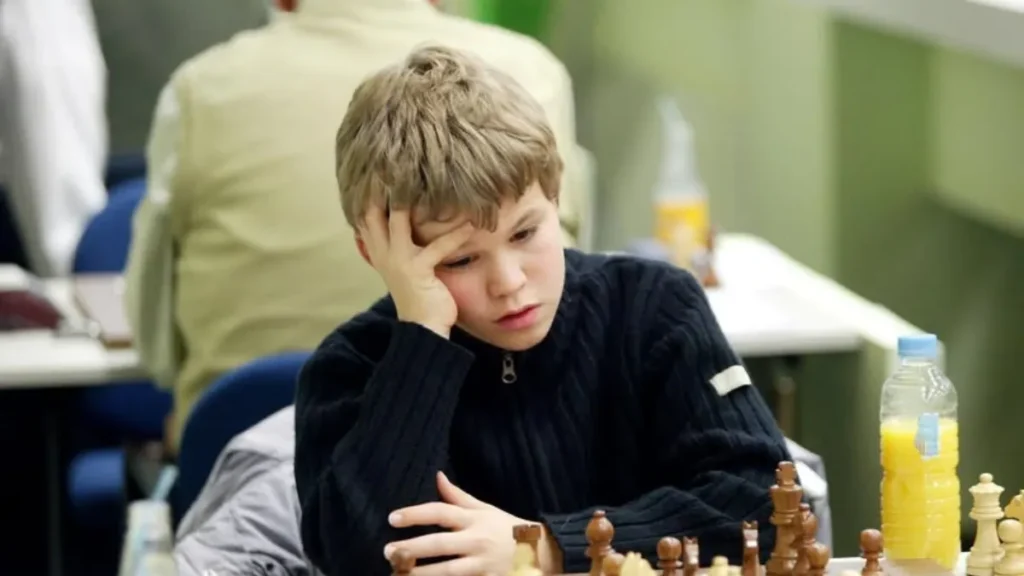
On July 31, 2000, a 9-year-old Norwegian boy with a modest rating of 904 walked into his first international chess tournament. Nobody knew it then, but that quiet moment marked the birth of a career that would redefine the game. That boy was Magnus Carlsen.
This feature retraces his earliest competitive outings, his first recorded victories, and the exact moments when the chess world began to notice something extraordinary unfolding.
The Peer Gynt Open: Where It All Began
Magnus had learned the moves at age five, but his competitive journey truly started in the summer of 1999 when he played in the junior section of the Norwegian Chess Championships. He finished with a respectable score, which fueled his desire to compete more seriously.
By July 2000, he was ready for a bigger stage. He entered the Peer Gynt Open in Gausdal, a small mountain village in Norway. The tournament was named after the famous Norwegian folk hero, and it would become the setting for Carlsen’s first official international games.
Round One: A Tough Opening
His first opponent was Aksel Brasoy, a 24-year-old player rated 1590. The gap in experience and rating was significant. Carlsen played black and fought hard, but ultimately lost the game. It was a harsh but necessary lesson in the realities of tournament chess.
Round Two: The First Win That Survives in History
The second round paired him against Jonathan Carlstedt, a German player of the same age who had traveled to Norway with his father specifically to gain tournament experience. Carlsen won that game, and it became the first game of his to be archived in the ChessBase Mega Database—the global repository of master-level chess games. From that point on, every move he made would be watched and recorded.
Breaking into the International Scene: Bad Wiessee 2000
Just three months after the Peer Gynt Open, Carlsen made his first appearance outside Scandinavia. He traveled to Bavaria, Germany, to compete in the Bad Wiessee Open in October 2000.
This tournament was a major step up. He was no longer playing against children or local amateurs; he was facing experienced adult players from across Europe. It was here that he first caught the attention of the international chess community.
Facing a FIDE Master: The Ingo Cordts Encounter
In Round 2, Carlsen was paired against Ingo Cordts, a German FIDE Master with decades of experience. Cordts later admitted that he initially took it easy because his opponent was just a child. But after Carlsen’s seventh move, he realized he was in a real fight.
“By the seventh move, I could tell this was no ordinary nine-year-old. He had real opening knowledge and a clear plan.” — FM Ingo Cordts
Carlsen sacrificed a pawn early to seize the initiative. Both players spent long minutes calculating. In the end, the youngster lost the thread and his king came under attack. Cordts won the game, but he later described it as one of the most memorable games of his career—not because he won, but because he had played a future World Champion.
At that time, tournament time controls were significantly different: 120 minutes for the first 40 moves, 60 minutes for the next 20 moves, and 30 minutes for the rest—with no increment. Young Carlsen handled the pressure remarkably well for his age.
A Year of Extraordinary Progress
What makes Carlsen’s story so remarkable is the speed of his development. In July 2000, he was rated 904. By December of the same year, his rating had surged past 2000. That kind of leap—more than 1000 rating points in less than six months—is almost unheard of in competitive chess.
He also claimed the Norwegian Under-11 Championship title that year, cementing his status as the country’s most promising young talent.
The Full Score: Carlsen vs. Carlstedt (Peer Gynt Open 2000)
Below is the complete game record from Carlsen’s first archived victory. It is preserved exactly as it was played on that summer day in Gausdal.
| Event: | Peer Gynt Open, Gausdal, Norway |
| Date: | July 31, 2000 |
| White: | Magnus Carlsen |
| Black: | Jonathan Carlstedt |
| Result: | 1-0 |
1. e4 e5 2. Nf3 Nc6 3. Bb5 a6 4. Ba4 Nf6 5. O-O Be7 6. Re1 b5 7. Bb3 O-O
8. c3 d5 9. exd5 Nxd5 10. Nxe5 Nxe5 11. Rxe5 c6 12. d4 Bd6 13. Re1 Qh4
14. g3 Qh3 15. Qf3 Bg4 16. Qxg4 Nf6 17. Qf5 Nh5 18. Bd2 Nf6 19. Na3 h6
20. Nc2 Ng4 21. Re2 Nxh2 22. Kxh2 Qh5+ 23. Kg2 Qg5+ 24. Kf1 Qxg3
25. Bxg7 Bc7 26. Kf1? Kxg7 27. Rg1 Qh2 28. Qg5+ Kh8? 29. Re7 Bb8? 30. Rh7# 1-0
What We Can Learn from His First Games
Carlsen’s early tournament games reveal several traits that would become his trademarks: fearless aggression, a willingness to sacrifice material for initiative, and an ability to keep fighting even in losing positions. He lost more games than he won in those first events, but he never stopped learning.
His first win in the database—against Carlstedt—shows a clear attacking intention from the opening. His game against Cordts, though a loss, demonstrated his capacity to challenge a much stronger opponent on equal terms. These were not the games of an average prodigy; they were the games of someone who would soon dominate the sport.
Key Milestones from Carlsen’s First Year
- First international tournament: July 2000, Peer Gynt Open, Norway
- First recorded win: Round 2 of the same event against Jonathan Carlstedt
- First international event abroad: Bad Wiessee Open, Germany, October 2000
- First high-level opponent: FM Ingo Cordts, who later described the game as unforgettable
- Rating growth: Climbed from 904 to over 2000 in just six months
- First national title: Norwegian Under-11 Champion (2000)
Where It All Led
Twenty-six years later, Magnus Carlsen stands as the highest-rated player in the history of chess, with five World Championship titles, a peak rating of 2882, and a record of 125 unbeaten games. Yet his story began with a loss to a 1590-rated amateur and a win against a nine-year-old from Germany.
Every legend has a beginning. For Carlsen, that beginning was July 31, 2000, in a small Norwegian town, with a rating of 904 and a dream that seemed impossibly distant. Today, it is part of chess lore—proof that greatness is not born overnight, but built one move at a time.

Prochess.Online
prochess.online is built and maintained independently, focused on free, privacy-first chess tools powered by Stockfish 18.